By
By 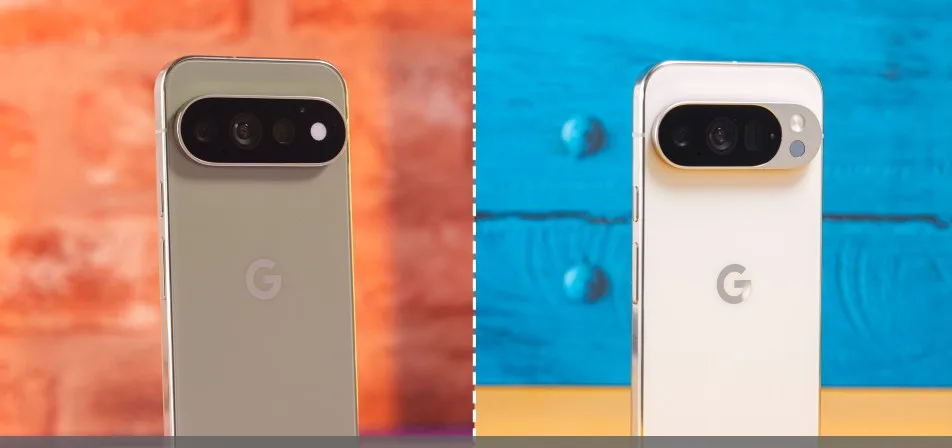
Google’s Pixel 11 Pro improves on the Pixel 10 Pro in several important areas, including performance, battery life and wireless charging. But the two phones share nearly the same design, display and camera hardware, making the older model a compelling alternative at its lower price.
The 256GB Pixel 11 Pro starts at about €1,100, while the 128GB Pixel 10 Pro has fallen to roughly €770. That substantial gap means buyers need to decide whether the newer phone’s upgrades justify paying more.
Design and display are almost unchanged
There is little to separate the phones physically. Both use Gorilla Glass Victus 2, an aluminum frame and IP68 dust and water resistance. Their dimensions and weights are also nearly identical, with body colors providing the main visible difference. The Pixel 11 Pro’s camera housing uses edge-to-edge glass, but this does not substantially change the overall design.
Both models have a 6.3-inch LTPO OLED display with a 1280 by 2856 resolution, a dynamic refresh rate from 1Hz to 120Hz and HDR10+ support. The newer phone is officially rated for higher brightness, but testing found only a small real-world difference: 2,426 nits for the Pixel 11 Pro compared with 2,351 nits for the Pixel 10 Pro in automatic brightness testing. Both screens remain excellent, so this category is effectively a tie.
Pixel 11 Pro delivers better performance and endurance
The Pixel 11 Pro uses Google’s Tensor G6 chip, while the Pixel 10 Pro runs on Tensor G5. Tensor G6 has seven CPU cores and uses the same 3nm manufacturing process, but Google claims a 50% increase in AI computing power and improved efficiency.
Benchmarks show the newer phone’s biggest advantage. Its CPU performance is almost 20% higher in single-core testing and more than 20% higher in multi-core workloads. Combined performance tests also show a meaningful improvement. However, the GPU performs at roughly the same level, and the Pixel 11 Pro’s base configuration includes 12GB of RAM. Every Pixel 10 Pro storage option comes with 16GB.
Battery life is a clearer win for the newer model. Despite having a slightly smaller 4,850mAh battery than the Pixel 10 Pro’s 4,870mAh cell, the Pixel 11 Pro recorded an Active Use Score of 15 hours and 38 minutes—3 hours and 33 minutes longer than its predecessor. Gaming and video streaming contributed most to the improvement.
Wired charging remains rated at 30W on both phones. The Pixel 11 Pro adds an Extreme Charging mode, but it does not meaningfully reduce charging times. Wireless charging is a more tangible upgrade: the newer phone supports 25W with compatible Qi2.2 magnetic chargers, compared with 15W on the Pixel 10 Pro.
Camera improvements are modest
The phones share a 50MP main camera, a 50MP ultrawide camera and a 42MP autofocus selfie camera. The Pixel 11 Pro’s telephoto camera uses a larger sensor, but that change does not produce a dramatic advantage in low-light photography.
In daylight, the Pixel 11 Pro generally captures slightly finer detail and handles sharpening more naturally. Its telephoto images are also somewhat cleaner at 5x and 10x magnification. In darker conditions, the newer model can produce cleaner telephoto images, although the difference is small. The Pixel 10 Pro’s ultrawide camera was actually sharper in low-light comparisons.
Video quality is similarly close. Both phones support 4K recording at 60 frames per second across their cameras, while cloud processing enables 8K at 30 frames per second. The Pixel 11 Pro’s key video advantage is HDR recording at 4K60; the Pixel 10 Pro is limited to 4K30 HDR.
Which Pixel Pro should you buy?
The Pixel 11 Pro is the better phone on paper, with longer battery life, a faster CPU, faster wireless charging and 4K60 HDR video. Its camera improvements are real but incremental, while the display and design are practically unchanged.
For most buyers, the Pixel 10 Pro offers better value. It looks almost identical, has the same display, delivers comparable overall camera results and includes more RAM in every configuration. Unless the newer model’s battery endurance, wireless charging or HDR video features are especially important, saving the difference makes the Pixel 10 Pro the more sensible choice.