By
By 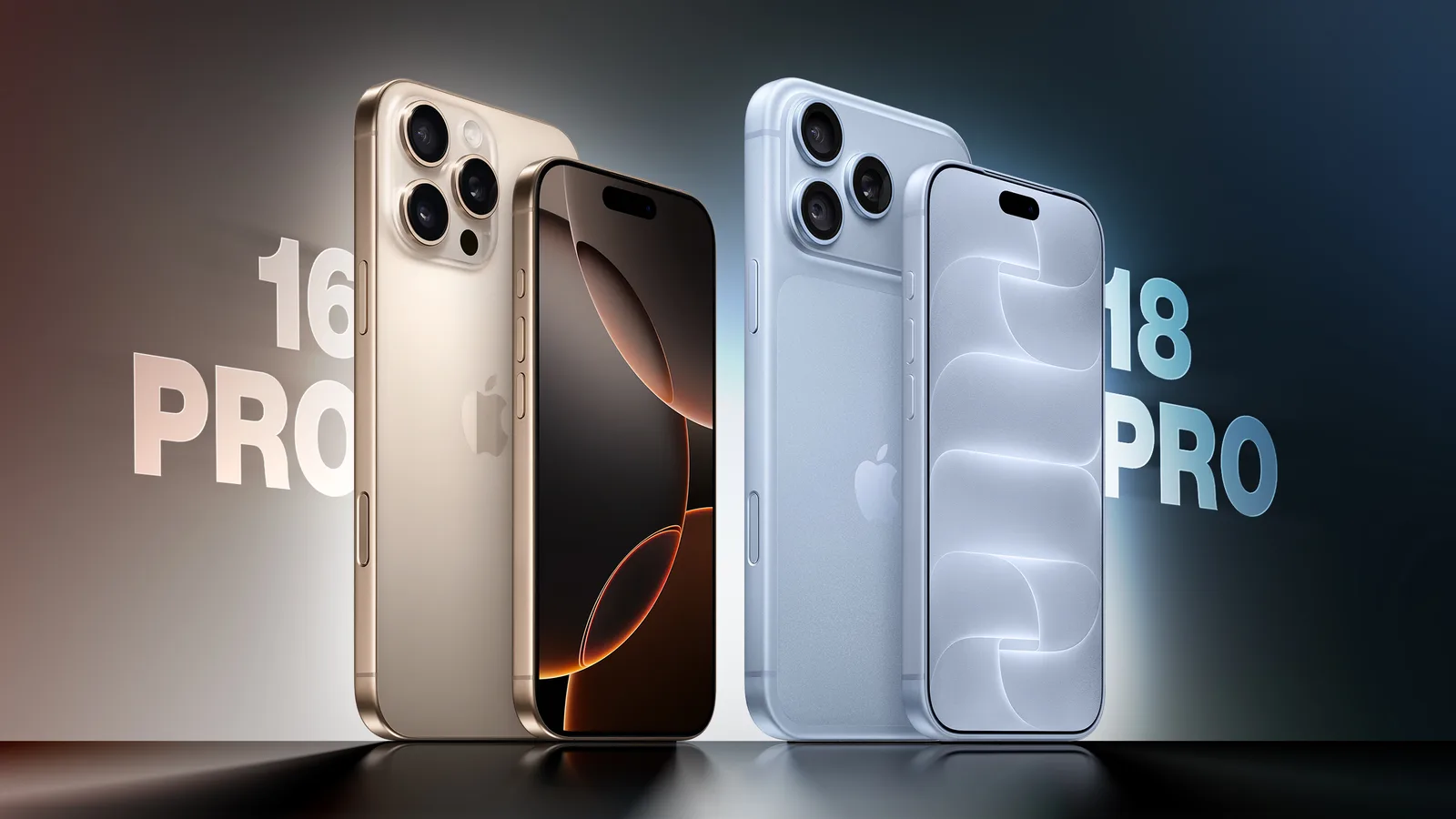
Apple's newly announced iPhone 18 Pro and iPhone 18 Pro Max arrive two years after the iPhone 16 Pro line, and skipping a generation stacks up more than 50 changes for owners of the 2024 model. Much of the visible redesign actually landed with last year's iPhone 17 Pro, so for iPhone 16 Pro users two rounds of upgrades combine into one of the largest jumps Apple has offered in a single move.
What changed in design and display
The iPhone 16 Pro's titanium frame and full glass back give way to an aluminum unibody with a partial Ceramic Shield back and a full-width camera plateau. The front now uses Ceramic Shield 2, which Apple says offers three times better scratch resistance, along with a new anti-reflective coating the older model lacks entirely.
The display also gets brighter, rising from 2,000 nits to 3,000 nits peak outdoors, with twice the outdoor contrast. A smaller Dynamic Island now supports up to three simultaneous Live Activities. The trade-off is weight: the iPhone 18 Pro Max is 22 grams heavier than the iPhone 16 Pro Max, a difference that is noticeable in hand.
Performance and connectivity gains
At the core is the A20 Pro, Apple's first smartphone chip built on TSMC's 2nm process. It pairs two super cores with four efficiency cores, adds a seventh GPU core with Neural Accelerators, and doubles the Neural Engine to 32 cores. RAM climbs from 8GB to 12GB, and memory bandwidth jumps to roughly 115GB/s. A second-generation vapor chamber — absent from the iPhone 16 Pro — should help with sustained gaming and long video captures.
Connectivity sees Apple's own silicon take over. The iPhone 18 Pro uses the Apple C2 modem in all countries (the Pro Max sticks with a Qualcomm modem in the U.S.), and the Apple N1 chip handles Wi-Fi, Bluetooth 6, and Thread.
Camera upgrades stack up
The camera system is substantially different. The telephoto jumps from 12 megapixels at 5x to a 48-megapixel Fusion sensor offering 4x and 8x optical zoom, while the front camera moves from 12 to 18 megapixels and adds Center Stage and ultra-stabilized video. The Main camera swaps its fixed ƒ/1.78 aperture for a four-stop variable aperture spanning ƒ/1.48 to ƒ/4.0, using six laser-cut blades.
Apple also adds Pro controls for manual aperture, shutter speed, white balance, and a histogram, plus ProRes RAW, Genlock, Dual Capture, Cinematic mode at 60fps, and Photographic Styles 3 with texture and grain controls. The company claims around 50% better low-light performance from the new Main sensor and pipeline.
Battery, charging, and pricing
Battery life sees Apple's largest-ever generational gain. The iPhone 18 Pro reaches up to 36 hours of video playback versus 27 on the iPhone 16 Pro, while the Pro Max rises from 33 to 45 hours. Charging is faster too, hitting 50% in roughly 15 minutes with a 60W-capable adapter, compared with 30 minutes previously.
The catch is cost. The iPhone 18 Pro starts at $1,199 for 256GB — $200 more than the iPhone 16 Pro's $999 launch price, though the entry storage has doubled. A new 2TB tier tops out at $2,399, or $2,499 on the Pro Max. Apple no longer sells the iPhone 16 Pro directly, so comparisons now involve a device you already own or a third-party listing.
Should you upgrade?
For iPhone 16 Pro owners, the iPhone 18 Pro is an easy recommendation given how the changes accumulate. But shoppers chasing the redesign, telephoto camera, or bigger battery should note that most of those arrived with the iPhone 17 Pro. A discounted iPhone 17 Pro delivers much of the same for less; the iPhone 18 Pro's true exclusives are the variable aperture and Pro controls, the C2 modem, the smaller Dynamic Island, and roughly three extra hours of battery. Pre-orders opened September 12, with availability from September 18.