By
By 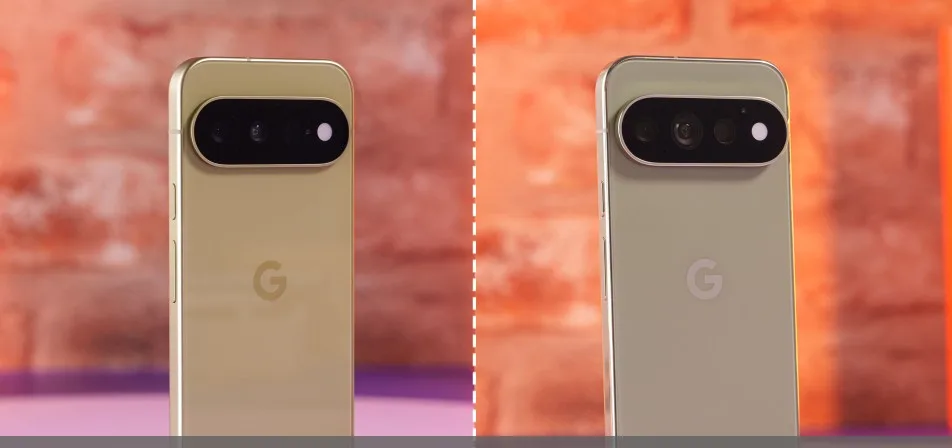
Google's Pixel 11 and Pixel 11 Pro are closely matched flagship phones, but the Pro model adds enough display and camera upgrades to justify its higher price for some buyers. The standard Pixel 11 starts at $899, while the Pixel 11 Pro begins at $1,069. Both offer the same Tensor G6 processor, similar battery life and a broadly comparable design.
For most people, the Pixel 11 delivers the essential Google flagship experience at a lower cost. The Pixel 11 Pro is aimed at users who want a more advanced screen, stronger zoom photography or more memory and storage.
Pixel 11 and Pixel 11 Pro design differences
The two phones use aluminum frames, Gorilla Glass Victus 2 and IP68 dust and water resistance. Their designs are nearly identical, although the finishes differ. The Pixel 11 combines a matte frame with a glossy rear panel, while the Pro uses a glossy frame and a frosted back.
The standard model is slightly lighter and offers a grippier finish. Its color options may also appeal more to buyers who prefer brighter designs. The Pro has a more subdued, mostly matte appearance that gives it a classier look.
Pixel 11 Pro has the better display
Both phones feature 6.3-inch OLED screens, but the Pixel 11 Pro has the more advanced panel. Its LTPO display supports a dynamic refresh rate from 1Hz to 120Hz and offers a 1280 x 2856 resolution. The Pixel 11 uses an LTPS OLED panel with a 1080 x 2424 resolution and switches between 60Hz and 120Hz.
The Pro also has higher advertised brightness, at 2,400 nits for automatic brightness and 3,600 nits at peak. Testing recorded 2,333 nits and 3,118 nits respectively, compared with 2,134 nits and 2,842 nits for the Pixel 11. The resolution difference is difficult to notice in everyday use, but the Pro's adaptive refresh rate is a meaningful technical advantage.
Same performance, battery life and charging
Both models run on Google's Tensor G6 chip and delivered effectively identical benchmark results. Stress testing showed each phone retained about 60% of its theoretical CPU performance and 70% of its GPU performance.
The Pixel 11 has a 4,985mAh battery, slightly larger than the Pixel 11 Pro's 4,850mAh cell. Despite that difference, both recorded an Active Use Score of 15 hours and 40 minutes. Charging is also the same: wired charging reaches 30W, while wireless charging supports 25W. Each phone reached 30% in 15 minutes, 60% in 30 minutes and a full charge in about 80 minutes.
Pixel 11 Pro wins the camera comparison
The camera system is the clearest reason to choose the Pro. Its main camera uses a larger sensor than the Pixel 11, while its 50MP telephoto and 50MP ultrawide cameras also use larger, higher-resolution sensors. The Pro's ultrawide camera adds autofocus, which helps with close subjects.
In daylight, both phones produce a similar Pixel-style look, but the Pro generally captures slightly sharper detail. Its advantage becomes more obvious at 5x and 10x zoom, where the telephoto camera delivers clearer fine detail. The Pro also holds a lead in most low-light main-camera and telephoto tests.
The standard Pixel 11 is not without advantages. Its main camera produces strong close-ups at 2x, and its ultrawide camera can sometimes look sharper in low light. Selfie quality is similar, although the Pro offers a wider field of view. For video, the Pro supports 4K at 60 frames per second on its ultrawide camera and adds a cloud-based 8K mode for rear cameras; the Pixel 11's ultrawide is limited to 4K at 30fps.
The Pixel 11 is the better value for buyers who want a compact flagship with strong cameras, long battery life and the same core performance as the Pro. Choose the Pixel 11 Pro if the LTPO display, better zoom, autofocus ultrawide camera, 16GB of RAM or 1TB storage option matters to you. Otherwise, the standard Pixel 11 covers the fundamentals for substantially less.