By
By 
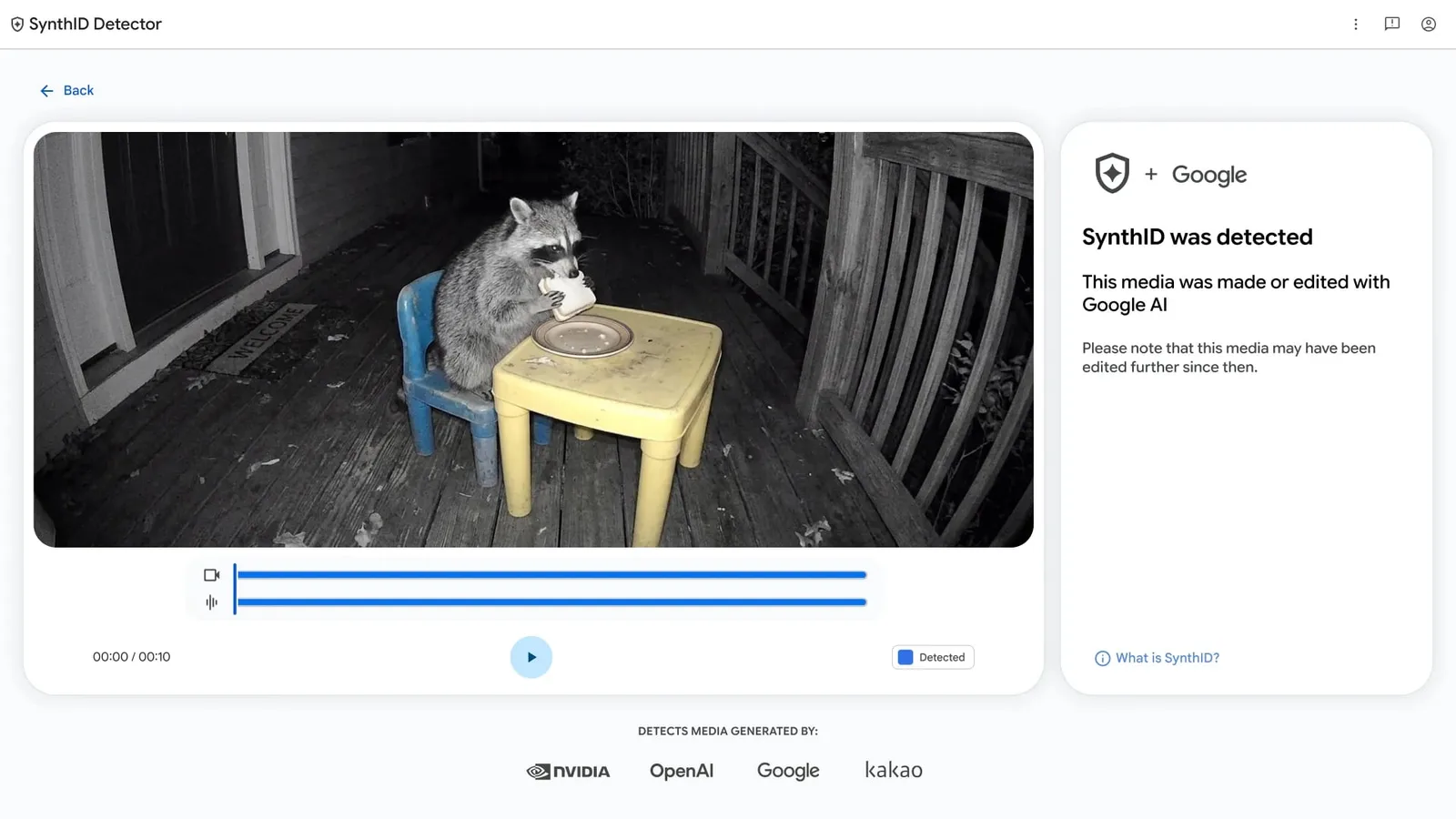
Google is opening its SynthID Detector to everyone worldwide, giving users a way to check whether an image, video, or audio file was created with AI. The tool is available in English through the SynthID Detector website and looks for invisible watermarks embedded in supported media.
The detector can currently identify watermarks associated with AI tools from Google, OpenAI, Nvidia, and Kakao. Google also says support for media created with Apple’s AI tools is coming soon.
How Google’s SynthID Detector works
SynthID embeds imperceptible watermarks into images, video, and audio during the creation process. The Detector scans uploaded media for those signals and reports whether it finds evidence that the file was generated with AI.
That approach makes the tool different from systems that attempt to judge content based only on visible artifacts or stylistic clues. However, the detector’s results depend on whether the media carries a SynthID watermark that it can recognize. It is not described as a universal test for every AI-generated file.
For users, the process is intended to be straightforward: visit the SynthID Detector website and submit an image, video, or audio file for analysis. Google previously offered access to an early version for selected media professionals, while Gemini could also be asked to assess individual pieces of media.
Which AI platforms can it identify?
The public version currently covers media watermarked by Google and three other AI providers: OpenAI, Nvidia, and Kakao. Google says Apple support will be added in the near future, expanding the number of AI ecosystems represented in the tool.
The announcement does not say that the Detector can identify content from every generative AI service. As a result, a file that receives no match should not automatically be treated as proof that it was made by a person. It may simply lack a supported SynthID watermark.
Google’s watermarking scale
Google says it has used SynthID to watermark more than 180 billion images and videos since the technology launched in 2023. The company also says it has watermarked “240,000 years of audio content” over the same period.
Making the Detector publicly available could give publishers, creators, and everyday users another way to investigate suspicious media. It may be especially useful as synthetic images, video, and audio become harder to distinguish from recordings made in the physical world.
The tool’s usefulness will ultimately depend on broader adoption of compatible watermarking systems. For now, it provides a direct way to check for known SynthID markers rather than attempting to determine the origin of every digital file.