By
By 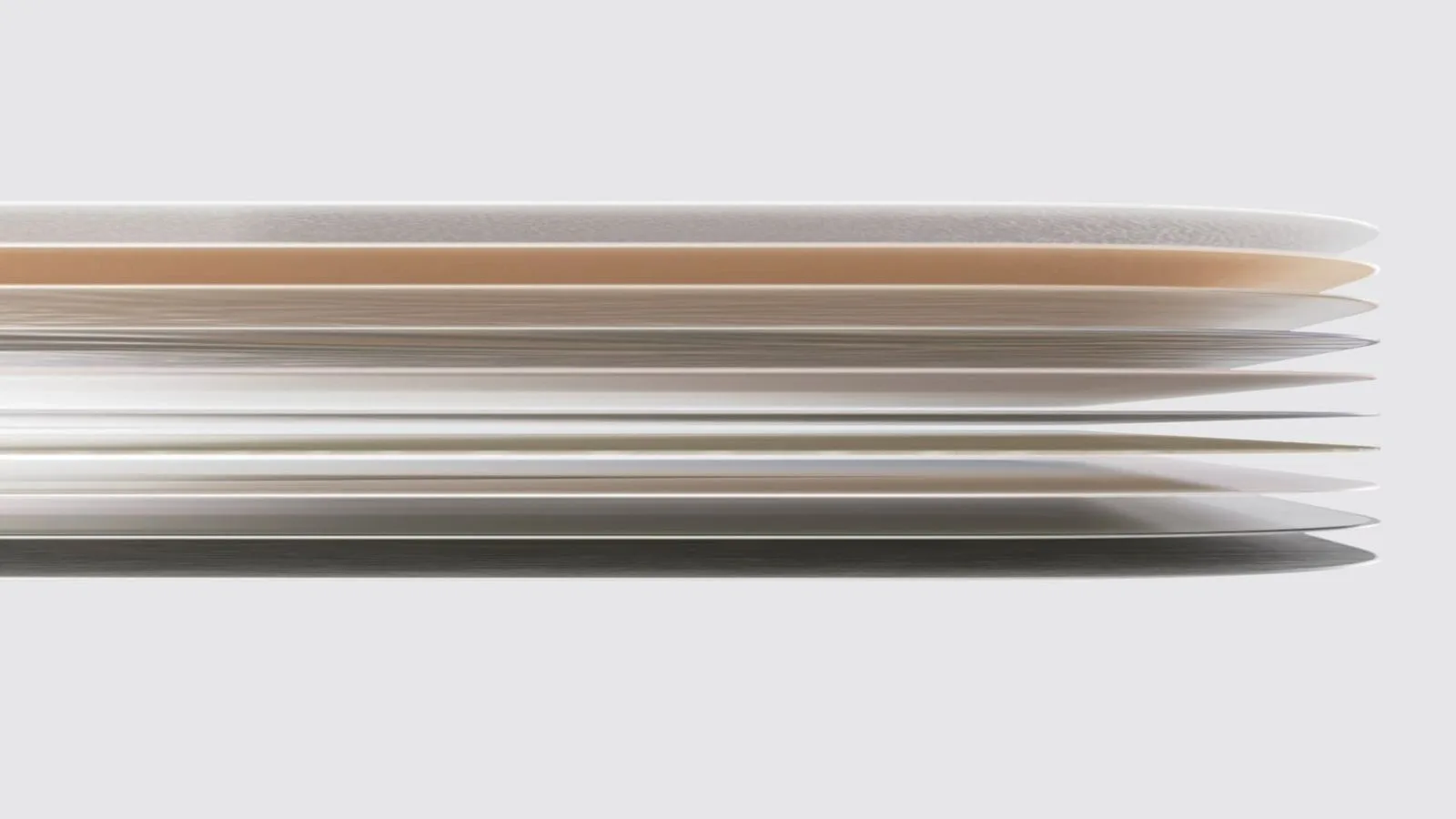
Apple has offered new detail on how the foldable inner display of its newly announced iPhone Duo is built, describing a 10-layer structure engineered to withstand repeated folding while minimizing visible creasing.
What's inside the folding screen
According to Apple, the inner display stack includes a nano-textured cover layer made from a custom polymer that the company says is up to 40 percent stiffer than "other materials used in the industry" — a comparison that appears aimed at rival foldable phones. Apple also added high-strength glass both above and below the folding display panel, along with a titanium plate positioned at the bottom of the stack for added structural support.
To help the layers move independently as the device folds and unfolds, Apple says it uses custom adhesives that let the layers "glide past one another like the pages of a book," a design intended to relieve bend stress at the crease and reduce long-term wear.
Durability and crease-hiding design
The exterior nano-texture finish on the inner display serves two purposes, according to Apple: cutting down on glare and making the fold line less visible when the phone is open. That layer is further protected by a scratch-resistant coating designed to guard against everyday scuffs.
Notably, the inner display does not use Ceramic Shield, the glass-ceramic material Apple applies elsewhere on the device. Instead, Apple says the custom polymer cover takes its place on the folding panel specifically, since a folding screen cannot use the same rigid glass-based protection as a flat display.
Ceramic Shield 2 on the outer display
The iPhone Duo's outer, non-folding display is covered by Ceramic Shield 2, the same protective material Apple uses on the iPhone 18 Pro models, while the back of the device is protected by standard Ceramic Shield. This split approach reflects the different mechanical demands of a screen that folds versus one that stays flat.
Shared display features across both screens
Despite their different physical makeup, Apple says both the inner and outer displays on the iPhone Duo support the same core display features, including ProMotion for adaptive refresh rates, Always-On display functionality, and True Tone color adjustment. Apple also states that both displays reach up to 3,000 nits of peak outdoor brightness.
Apple unveiled the iPhone Duo, its first foldable iPhone, on September 9. The device pairs two screens into what Apple describes as a single continuous frame sharing the same aspect ratio when open, and Apple says the transition between the folded and unfolded states was designed to feel fluid rather than mechanical. When fully unfolded, Apple states the iPhone Duo is the thinnest iPhone it has ever produced.
The engineering details Apple has shared underscore how much of the Duo's design centers on solving the durability and crease problems that have challenged foldable phones industry-wide, a factor likely to influence how the device is received once it reaches customers.